

When searching for thermal optics for hunting online and the same names keep showing up. AGM. Pulsar. ATN. Good thermals, no doubt about that. But there’s that European optics brand that most American hunters never discover, simply because it doesn’t get pushed on popular hunting channels and podcasts.
That brand is Liemke.
Built in Germany. Backed by the Blaser Group – the same powerhouse behind Blaser, Mauser, and J.P. Sauer rifles. And available right now in the US, with no multi-month import wait.
Why European Thermal Engineering Hits Different
Night hunting in Germany and Central Europe isn’t a weekend hobby. It’s a serious, heavily regulated discipline practiced in dense, fog-choked forests under strict legal and ethical obligations.
That environment is what forged Liemke’s engineering philosophy – and every unit they build reflects it.
Liemke thermal optics run high-end Vanadium Oxide (VOx) sensors paired with proprietary in-house image processing. The result is exceptional temperature sensitivity that pulls an animal’s body heat out of heavy humidity, fog, and rain with real clarity – not the washed-out mush you get from lesser sensors.
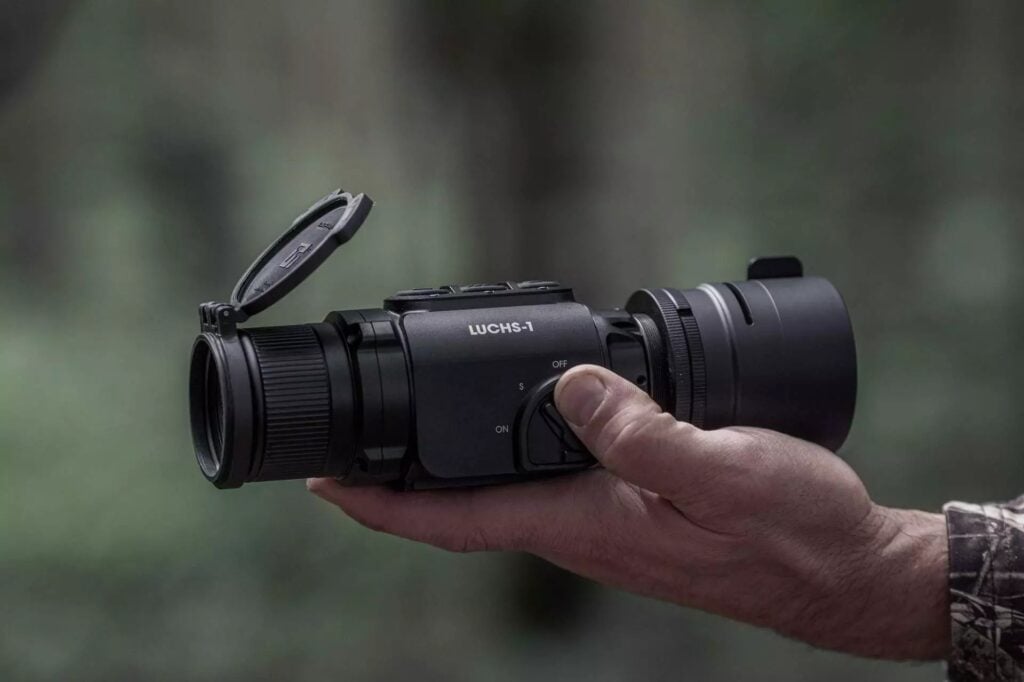
The flagship Luchs and Keiler lines have already made noise in the US market. Outdoor Life named the Luchs-1 “Best Clip-On Thermal” in a head-to-head industry test. Field Ethos hunting editor Jeff Johnston – a man who’s run most everything on the market – called it one of only two thermals he’d stake his reputation on, alongside the Trijicon REAP-IR. That’s serious company.
Both flagship families feature Liemke’s proprietary Sun and Rain image modes, which automatically optimize contrast for high and low-contrast environments. Five color palettes, including the exclusive Extra Dark setting that protects your natural night vision, give hunters full command of the field picture.
But today, we’re talking about Liemke’s legacy lineup – the Merlin and Sperber families.
Older Generation Doesn’t Mean Inferior
Thermal imaging sensors operate by detecting heat radiation, not visible light. The two sensor resolution tiers that dominate the market of thermal optics for hunting, 384×288 and 640×512, have been largely mature technologies for several years now. A 384-resolution uncooled VOx microbolometer from Liemke’s Merlin series reads heat signatures the same way a brand-new 384-sensor does. Physics doesn’t care about model years.
What does change with each new generation? Mostly software features, app connectivity updates, and cosmetic redesigns.
What Liemke’s older Merlin and Sperber lineup offers instead is something that genuinely matters: robust German-manufactured housing, precision-ground optics, reliable firmware, and a 3-year warranty.
Exploring Liemke Thermal Monoculars, Scopes, and Clip-ons
Merlin-13: The Compact Tracker
Some hunters travel light. Everything on their kit earns its weight or it stays home. The Merlin-13 was built for those hunters.
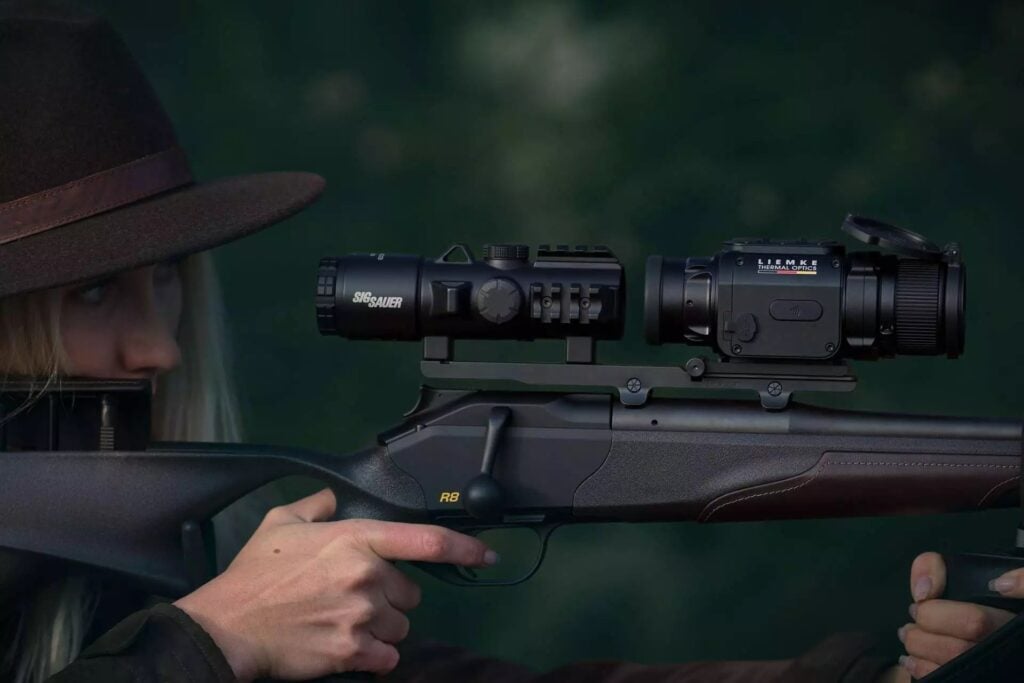
At just 4.5 ounces, it’s one of the most compact thermal clip-ons on the market – small enough to pocket during a stalk, yet capable enough to clip onto any day optic.
Under the hood, it carries a 256×192 VOx detector with a 12µm pixel pitch and a 50Hz refresh rate, delivering a field of view of about 24 meters at 100 meters and a detection range out to 675 meters. That’s solid coverage for close-range brush work and dense forest stalking.
The 1,024×768 OLED display keeps the picture sharp, and the IP67 rating means rain, mud, and cold nights are nothing to worry about. It runs on a single CR123 battery for up to 3.5 hours – enough to cover a full evening stalk. When you’re done hunting, pull it off the scope and use it as a handheld thermal monocular. One tool, two jobs.
For the mobile stalker or forest hunter who needs capable thermal performance without compromising rifle handling, the Merlin-13 is worth considering.
Sperber-1: The Traditionalist’s Thermal Riflescope
Designed in the classic style of a traditional daylight scope, the Sperber-1 features a clean, slim aluminum housing that mounts using standard scope rings, preserving the clean, traditional aesthetic of your hunting rifle.
However, inside, the Sperber-1 packs a 384×288 VOx ceramic detector with 12µm pixel pitch, driven by a 1280×960 LCOS color display at 50Hz for smooth, real-time imaging. The detection range is 1,750 meters. The 35mm lens provides 3-12x magnification and a FOV of 13.2 meters at 100 meters – comfortable territory for both forest and open-field hunting.
What really sets the Sperber-1 apart is its battery life: up to 15 hours, combining an integrated rechargeable battery with an additional removable battery pack. Add WiFi connectivity and 16GB of internal memory, and you have a thermal scope that performs as cleanly as it looks.
Merlin-35: The Versatile Hybrid
Can’t decide between a handheld thermal monocular and a clip-on scope attachment? With the Merlin-35, you don’t have to.
During the stalk, carry it as a standalone thermal monocular. Scan the field. Pick up movement. Confirm what you’re looking at before the rifle ever comes up. Then clip it onto your day scope, take the shot, and go home. Your zero stays intact. Your eye relief doesn’t change. Your native rifle setup is untouched.
The Merlin-35 runs a 384×288 VOx ceramic detector with a 17µm pixel pitch at 50Hz, with temperature sensitivity better than 50mK. Field of view runs 19 meters at 100 meters with a detection range out to 1,480 meters. The 1,024×768 OLED display delivers a sharp, detailed picture across all conditions, and the IP67-rated aluminum housing handles the elements without complaint.
It runs on two CR123 batteries for up to 3.5 hours, with external power supply support via micro-USB for longer setups from a vehicle or fixed position. The built-in stadiametric rangefinder lets you estimate distance using deer or wild boar reference points. WiFi connectivity is on board for app access and file transfer.
Merlin-42 & Merlin-50: The Long-Range Powerhouses
Open terrain changes the equation entirely. At 400, 600, 800 yards and beyond, proper target identification is a legal and ethical necessity. You need to know whether that animal is a coyote or a neighbor’s dog before you squeeze the trigger.
The Merlin-42 and Merlin-50 were built for exactly this task.
Both run large-diameter Germanium objective lenses – 42mm and 50mm respectively – that maximize thermal light transmission for superior image brightness and contrast at distance. Both carry IP67 protection and built-in compass and position sensors for orientation data displayed in real time at the top of the screen.
The Merlin-42 pairs its 42mm objective with a 384×288 VOx detector and 17µm pixel pitch, achieving detection ranges up to 2,100 meters with a field of view of 15.4 meters at 100 meters. Battery life runs to 2.5 hours on two CR123 batteries, with external power support via USB-C. It supports up to four memory locations for image shift coordinates, so you can run it on multiple rifles without re-zeroing each time.
The Merlin-50 steps things up considerably. Its 50mm objective feeds a 640×512 VOx detector with a 12µm pixel pitch, pushing detection range out to 2,597 meters with a field of view of 15.4 meters at 100 meters. Battery life extends to 4.5 hours on two CR123s, with USB-C external power support. It also features built-in Ultra Clear (UC) mode for high-humidity conditions, a dedicated E-zoom center adjustment to keep your point of aim precise at higher magnification, and the same four-group memory system for multi-rifle setups.
Both units are built for serious predator hunting and pest control at scale – wide agricultural fields, mountain pastures, sprawling ranch land. If you’re running open country after dark, these are the tools for the job.
The Liemke optics are made in Germany. The brand belongs to the German Blaser Group portfolio.
- KEILER Family: Purpose-built as handheld thermal monoculars meant for scanning, spotting, and tracking game over long distances.
- LUCHS Family: Dual-use systems designed primarily as front-mount clip-on attachments that mount directly to the objective bell of traditional day riflescopes. They can also be used as handhelds.
Liemke Merlin and Challenger are the brand’s discontinued thermal optics lineups.
- MERLIN Series: Liemke’s original line of front-mounted clip-on thermal attachments.
- CHALLENGER Series: Budget-friendly, entry-level handheld scanning monoculars.
- Older KEILER Generation: Prior to the modern Keiler-1/Keiler-2 revamp, this line consisted of older monocular platforms like the flagship Keiler-35 PRO.
Almost all models can record video, but the method depends on the generation:
- New Models (KEILER & LUCHS): YES. They record directly to an integrated 32 GB internal hard drive. You can download files via USB-C or wirelessly through the LIEMKE Mobile App.
- Discontinued Handhelds (Legacy KEILER PRO & CHALLENGER): YES. They feature internal memory (16 GB for Keiler PRO, 8 GB for Challenger). Videos must be extracted via a USB cable, as they do not support wireless transfer to the modern app.
- Discontinued Clip-Ons (MERLIN series): APP ONLY. These legacy units lack internal storage to save space. To save video, you must connect the optic to your phone via Wi-Fi and record the live-stream feed directly to your phone’s camera roll.



Leave a Reply