

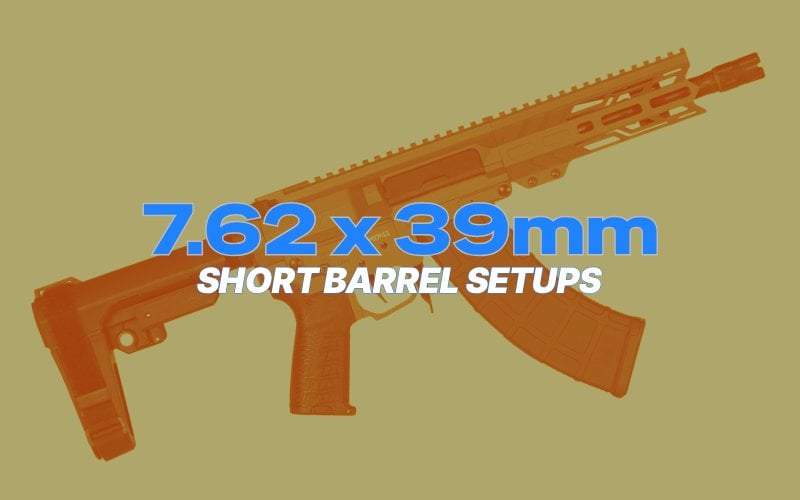
Ask around about a 7.62×39 AR and you’ll get two completely different answers. One camp says they’re unreliable junk. The other says they run great once you know what you’re doing. Both are describing real experiences – the difference comes down to a handful of specific parts.
Here’s what actually matters if you’re building or buying one.
Why 7.62×39 makes sense in a short barrel
The biggest surprise for people coming from 5.56 is how little velocity 7.62×39 gives up when you shorten the barrel.
5.56 depends on speed for terminal performance, so chopping the barrel below 11.5 inches or so hurts it in a real way. 7.62×39 was never a high-velocity round to begin with — it’s a lower-pressure cartridge pushing a heavier bullet with faster-burning powder — so there’s simply less to lose.
Going from 16 inches down to 7.5 inches costs you somewhere around 400 fps, roughly 18% of your muzzle velocity, or about 45 to 50 fps per inch. The same cut on a 5.56 gun tanks performance and turns your round into something closer to a pistol cartridge.
Typical chronograph numbers across different lengths:
| Barrel Length | Velocity (approx.) |
|---|---|
| 16″ | ~2,300–2,350 fps |
| 11″ | ~2,200 fps |
| 9″–10.5″ | ~2,080–2,200 fps |
| 8″ | ~1,900–1,950 fps |
| 7.5″ | ~1,900–1,920 fps |
Where it gets debated is the top end. The argument for 16 inches is full powder burn, and hunting data puts peak velocity somewhere in the 21 to 23 inch range – but roughly 90% of maximum velocity is already there by 12 inches. Chronograph a 10-inch barrel against a 16-inch on the same ammunition and the gap is often under 200 fps, which is not much to carry six extra inches for.
The losses flatten out well before you get anywhere near a full-length rifle. That’s the whole case for this cartridge in a short gun.
Picking a length actually depends on what you’re doing with it
6.25″ to 7.5″— Loud, flashy, fun, and more of a range toy than a serious defensive setup unless you’re running a suppressor. Unsuppressed, the report is brutal indoors and the flash will wreck your night vision in a dark room. Guns like the Micro Draco live here. Great time, not a defense gun.
7.5″ to 9″ — Workable but come with trade-offs – more muzzle flash, louder blasts, and can be less accurate with magnified optics calibrated for higher velocities. Better suited to dedicated range guns or suppressed pistol builds.
10″ to 12″ — This range is the best for an all-around build. It balances a reasonably complete powder burn, manageable noise and flash, and practical size. 12.5″ is specifically great for suppressed builds since velocity loss against 16 inches is minimal, and the balance with a suppressor mounted is better than a 16-inch carbine.
For hunting or shooting out to 150-200 yards, don’t go too short. Under 12 inches you start compromising expansion.
Four ways to get yourself a 7.62×39 pistol
A standard AR-15 lower running AR-pattern 7.62×39 magazines
This is the cheapest way into the caliber and the one most people default to without realizing what they’re signing up for. You take a standard AR-15 lower and pair it with a 7.62×39 upper. In this case, you’ll need specialty 7.62×39 AR-15 magazines that are shaped on the outside to fit inside a standard mil-spec AR-15 lower receiver magwell. Duramags or ASC magazines are your best bet here.
If you would rather buy a complete build, the Diamondback DB15 is available as a compact 7-inch ARP. Budget an extra hundred dollars for high-quality magazines and a spare bolt. Out of the box, these rifles ship with 28-round metal magazines. Budget another hundred dollars for spare magazines (stick to Duramag or ASC) and a bolt.
Two other names worth knowing if you’re building rather than buying complete: PWS and YHM both make great 7.62×39 uppers meant to drop directly onto standard AR-15 lowers while accepting 7.62×39 magazines magazines. PWS runs a piston system (11″ or 16″) and YHM runs direct impingement (10.5″).
A dedicated AK magazine lower receiver
Rather than fighting the extreme taper of the 7.62×39 cartridge inside a straight AR magwell, this approach removes the problem entirely by using a hybrid lower receiver designed to feed straight from rock-and-lock AK magazines.
CMMG Mk47 line (Banshee, Resolute, Dissent) is the platform most famously associated with this concept – you keep AR-15 controls, AR-15 modularity, and a bolt sized more like an AR-10’s to handle the larger case head.
PSA’s KS-47 is the budget version of the same concept. It solves the magwell geometry problem the same way, though it doesn’t carry the upgraded bolt that CMMG builds around, so durability is worth keeping an eye on if you go that route.
An actual AK pistol
No feeding problem, because nothing was adapted. Native magazines, native ergonomics, the platform this cartridge was designed around. You give up the AR accessory ecosystem and learn a different manual of arms, and in exchange you get a gun that just works and usually costs less.
The more expensive Micro Draco (HG2797) is the Romanian Cugir-built gun, while the VSKA Micro Draco is Century Arms‘ in-house build.
Neither – a piston gun built around the cartridge from the ground up
The CZ Bren 2 MS sits in its own category here. Short-stroke gas piston, chrome-lined barrel rated for a long service life, adjustable gas regulation, AR-style ambidextrous controls. It’s not cheap, but it’s built to a different standard than a converted AR-15, and it shows in how it runs.
The parts that determine reliability
Every reliability complaint about 7.62×39 ARs comes down to one of these:
Magazines
Failure point number one. The 7.62×39 case has far more taper than 5.56, and a straight AR magazine body doesn’t want to stack that shape reliably no matter how well it’s made. This is why so many first-time builders conclude the platform is junk when the actual problem is sitting in the magwell.
Buy magazines built specifically for the cartridge – Duramag, ASC, or Unimag.
Bolt
The 7.62×39 case head is noticeably wider than 5.56’s, which means more material gets machined off the bolt face to fit it. Less material means thinner locking lugs, and thinner lugs are this platform’s known wear point. It’s not a reason to avoid the gun, but treat a spare bolt as a consumable part rather than an upgrade.
Extractor and Firing Pin
Steel-cased ammunition — which is most of what these guns eat, because it’s cheap — doesn’t expand and release the way brass does, and it’s harder on extraction. A heavier extractor spring or an o-ring fixes most of that.
The bigger issue is primers. Steel-cased 7.62×39 ammo uses harder primers than commercial brass ammunition, and a lot of “unreliable” builds are really just standard firing pins not hitting hard enough. The fix is an enhanced or slightly longer firing pin paired with a stronger hammer spring. You need both – doing one without the other won’t solve it.
Gas System
Short barrels overgas easily and 7.62×39 is no exception. An adjustable gas block is the single best functional upgrade you can put on one of these. Carbine-length gas for anything under 16 inches.
Muzzle Thread
Check your thread pitch before ordering a muzzle device. AR-pattern 7.62×39 barrels typically run 5/8×24, while AK-pattern barrels use 14×1 left-hand. These get mixed up constantly.
7.62×39 vs .300 Blackout in a short-barrel setup
.300 Blackout was purpose-built to burn completely in an 8 to 10 inch barrel, runs on standard AR bolts and magazines with zero modification, and suppresses noticeably better because its higher chamber pressure works with a short barrel rather than against it. Running subsonic ammunition through a can, 300 BLK does something 7.62×39 was never designed to do as well.
What you pay for that is ammunition cost. Steel-cased 7.62×39 remains meaningfully cheaper per round in most markets, and outside of suppressed subsonic use it has a real edge in barrier penetration. Factor in dedicated magazines, an enhanced firing pin, and a spare bolt and the savings take a while to pay off – but on a gun that gets shot regularly, 7.62×39 still comes out ahead.



Leave a Reply